
In rural regions, Ultraviolet (UV) disinfection is a standard treatment method for both surface and groundwater sources. These systems are readily accessible through major hardware retailers, licensed plumbing professionals, and specialized water treatment providers. The technology effectively inactivates pathogenic bacteria, viruses, and parasitic protozoa such as Cryptosporidium and Giardia thereby significantly mitigating the risk of waterborne illness.
Ultraviolet (UV) disinfection systems have transitioned from a specialized technology to a standard fixture for properties utilizing private groundwater sources in rural Canada. Homeowners have increasingly adopted UV systems as a primary water quality safeguard; this shift is driven by the technology’s ability to provide a “chemical-free” barrier against common Canadian waterborne threats.
Rural water sources are vulnerable to agricultural runoff, septic system seepage, and seasonal flooding, which can introduce high levels of E. coli, viruses, and parasites like Cryptosporidium. Because these “biologicals” are often invisible and odourless, the UV system acts as a final, fail-safe barrier. By damaging the DNA of these pathogens, the system ensures that even if the source water becomes contaminated, the water reaching the tap is microbiologically safe for consumption.
UV System Operation
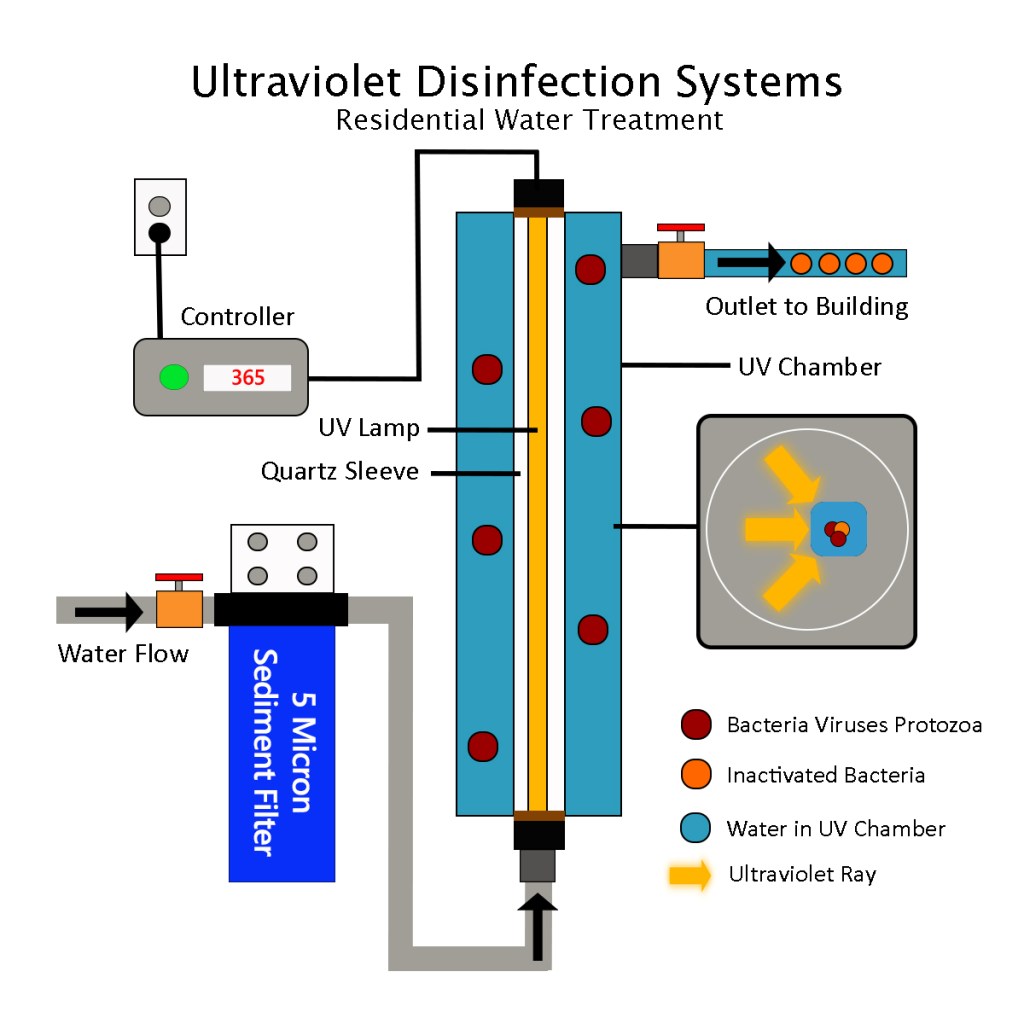
Disinfection is achieved within a stainless steel chamber where water is exposed to ultraviolet radiation. The UV lamp, housed in a protective quartz sleeve to prevent direct water contact, provides 360 degree radial distribution. This process ensures the immediate neutralization of microorganisms without the introduction of chemical by-products.
Residential UV disinfection systems consist of a stainless steel chamber, which serves as the reactor vessel where water is exposed to UV light, and an ultraviolet lamp (bulb) that acts as the light source generating germicidal UV-C energy. This lamp is housed within a quartz sleeve, a transparent tube that protects the lamp from water contact while allowing maximum light transmittance. The system is managed by a power controller (ballast), the electrical component responsible for regulating power and monitoring system alarms. Finally, o-ring(s) serve as high-quality seals to prevent water from leaking into the electrical housing or the quartz sleeve.
Pre-Treatment of the Water is Important
Proper prefiltration to achieve 5 micron particle removal is generally recommended by many ultraviolet disinfection system manufacturers, as this prerequisite is vital for maximizing the efficiency of the UV system. When particles of sediment are larger than 5 microns, they create shadowing effects or “shields” that block the UV-C rays, preventing the necessary microbicidal dose from reaching target pathogens, such as bacteria and viruses, flowing through the UV stainless steel chamber.
Particulate matter, color, iron, manganese, and organic compounds absorb or scatter UV light. This dramatically reduces the Ultraviolet Transmittance (UVT) of the water. A lower UVT means less germicidal energy reaches the target organisms, effectively reducing the overall UV dose below the required level for inactivation. By mechanically removing these larger particulates, the water achieves the clarity required (i.e., low turbidity), ensuring a clear optical path. Once this physical interference is eliminated, the UV-C energy can properly penetrate and disrupt the microbes’ DNA or RNA, achieving effective disinfection.
Additionally, many rural wells experience high water hardness due to the presence of dissolved minerals such as calcium and magnesium. Hard water can lead to scaling in pipes and water treatment systems, potentially reducing the effectiveness of UV disinfection by creating a layer of mineral deposits on the UV quartz sleeve, which blocks the transmission of ultraviolet light.
UV System Maintenance
Maintenance is critical to ensuring the ongoing microbiological safety of a water supply. Every ultraviolet (UV) disinfection system requires a maintenance service schedule, including lamp replacements, quartz sleeve cleaning, O-ring replacements, and the periodic disinfection of downstream plumbing.
To maintain the system’s germicidal effectiveness, UV lamps typically require replacement on an annual or bi-annual basis; most modern controllers include an integrated alarm or reminder feature to signal when this service is due. Furthermore, the installation of a 5 micron sediment filter upstream is essential; this pre-treatment ensures that the UV radiation can achieve direct contact with bacteria by preventing “shadowing,” where suspended particles shield pathogens as they pass through the reactor chamber. Finally, the integrity of the quartz sleeve is imperative to the disinfection process. It must be cleaned frequently and replaced immediately if it exhibits signs of calcification, etching, pitting, or permanent discoloration, as these surface imperfections significantly reduce UV transmittance.
UV Maintenance is More Than Just Replacing the Lamp / Bulb
While the annual replacement of the ultraviolet lamp is a standard practice for maintaining the required germicidal dosage, additional essential maintenance requirements such as quartz sleeve cleaning and O-ring replacement are frequently overlooked or neglected in rural water UV installations.
Water Testing
In rural areas served by groundwater sources, the installation of an ultraviolet (UV) disinfection system is frequently prompted by laboratory results confirming the presence of E. coli or total coliform bacteria. The detection of these specific microbial indicators serves as the primary catalyst for implementing UV technology as a critical corrective measure to ensure potable water safety.
To ensure the proper disinfection rates of an ultraviolet (UV) disinfection system, a water analysis of the groundwater source is required prior to installation. It is professionally recommended to test for hardness, iron, sulfur, tannins, manganese, turbidity, and Total Dissolved Solids (TDS). Failure to conduct a comprehensive water analysis prior to installation can severely compromise the effectiveness of a UV disinfection system. Without addressing these specific parameters, the system may operate inefficiently, leading to “breakthrough” where microbiological pathogens bypass the germicidal barrier and enter the household water supply entirely undetected.
Groundwater Case Study
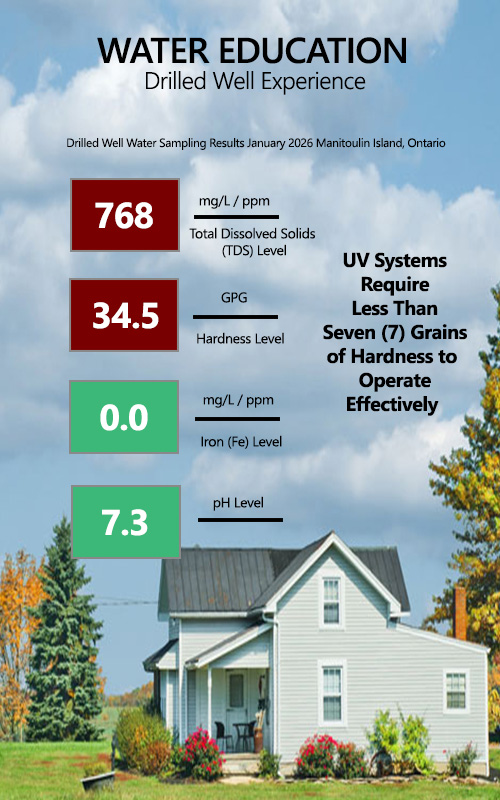
During the closing process for a rural property on Manitoulin Island, a mandatory water potability test was conducted to satisfy the conditions of the Purchase Agreement. While the results confirmed the absence of E. coli, the total coliform count was recorded at 72. These findings were unexpected, as the property’s drilled well is equipped with a filtration system, including a five-micron sediment filter and a UV sterilization unit.
The property’s water supply is serviced by a deep drilled well. A recent water quality analysis revealed a hardness level of 34.5 grains per gallon (GPG). This value significantly exceeds the maximum threshold of 7 GPG established by UV system manufacturers as a prerequisite for effective operation.
Consequently, the ultraviolet quartz sleeve had developed significant calcium scaling. This accumulation obstructed the UV output, preventing the system from achieving the necessary disinfection levels required for microbiologically free water.
Due to the lack of preliminary water testing prior to installation, the filtration and UV systems were unable to effectively neutralize the bacteria present. Furthermore, the absence of a failure alarm or indicator meant the system failure went undetected during regular operation.
Proper use of an Ultraviolet Disinfection system can reliably provide bacterial disinfection of water sources. This should be based on water testing, proper installation practices and sizing the system for the flow of water.
Effective UV disinfection of groundwater sources is not a “set and forget” solution; it requires a proactive approach to water quality. To ensure a system operates within manufacturer specifications, requirements for source water characteristics, flow demands, and the critical need for five-micron pre-filtration should be met. Selecting a system with an integrated performance alarm is a vital final step, providing the necessary fail-safety to guarantee that water remains disinfected and microbiologically free from contamination.
For more information on water treatment and safety, refer to Jeff Wahl, a Canadian water educator, dedicated to raising awareness about effective water purification methods and the limitations of UV disinfection. With twenty eight years of experience in the water treatment industry, Jeff has worked extensively in water quality assessment, filtration technologies, and public education on safe drinking water practices. He has conducted seminars, written articles, blogs, and advised private households on the importance of multi-barrier water treatment solutions. His expertise helps bridge the gap between technical knowledge and practical implementation, ensuring that homeowners have access to safe and reliable drinking water.
Volume 9 Issue 2 Wahl H2O – Water Awareness
Copyright 2026 Jeff Wahl | Wahl Water | All Rights Reserved
Contact Jeff via email jeff@wahlwater.com





Leave a Reply